MingAD 1368–1644
Ming Political Corruption and Social Unrest
Mid to Late Ming
In the mid and late Ming emperors neglected government, eunuchs seized power and factions fought; the Wanli Emperor skipped court for over twenty years and land annexation worsened.
View on the timeline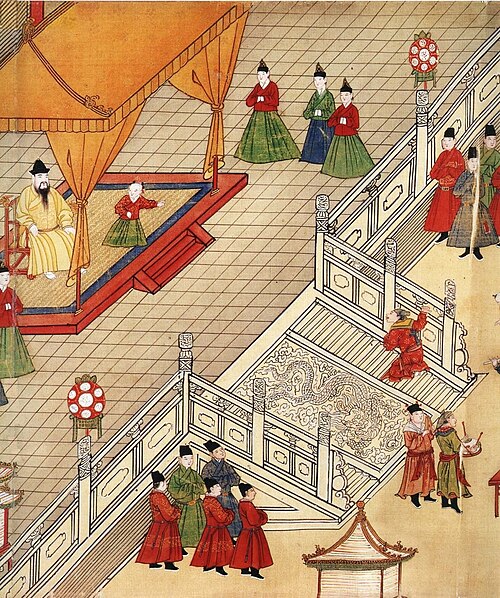
In the mid and late Ming, though the economy clearly grew, politics grew ever more corrupt and most emperors indulged in pleasure and neglected government. The Zhengtong Emperor trusted the eunuch Wang Zhen and in 1449 was captured by the Oirats in the Tumu Incident. The Zhengde Emperor left government to the eunuch Liu Jin and amused himself in the "Leopard Chamber" and traveled widely. The Jiajing Emperor revered Daoism and did not attend court for over twenty years, while the powerful minister Yan Song monopolized power for twenty years and took bribes. The Wanli Emperor reigned 48 years, did not attend court or read memorials for over twenty years and left many official posts unfilled, paralyzing many offices. The Tianqi Emperor loved carpentry, making wooden objects year after year and leaving government to the eunuch Wei Zhongxian. Wei ran the Eastern Depot, purged rivals, and officials everywhere built "living shrines" to him; he was called "Nine Thousand Years". The ruling elite was riven by intrigue and ministers formed cliques, with the Donglin faction and the eunuch faction attacking each other. Meanwhile Zhang Juzheng in the early Wanli reign carried out reforms, tightening official discipline, surveying land and introducing the "Single Whip" tax, which improved finances for a time, but most were abandoned after his death. Court chaos steadily weakened the center's control of society, law and discipline slackened, and officials at all levels took bribes and squeezed the people. The imperial family, nobles, eunuchs, officials and landlords seized land wildly; for example, Zhu Changxun, Prince of Fu, son of the Wanli Emperor, was granted 20,000 qing of land in Henan, and many peasants lost their land and drifted.
References
Text and images from Wikipedia are used under CC BY-SA and their respective licenses