YuanAD 1271–1368
Guo Shoujing Completes the Shoushi Calendar
Early Yuan
The Yuan scientist Guo Shoujing and others compiled the Shoushi Calendar, which fixed the year at 365.2425 days, the same as today's Gregorian calendar but about 300 years earlier.
View on the timeline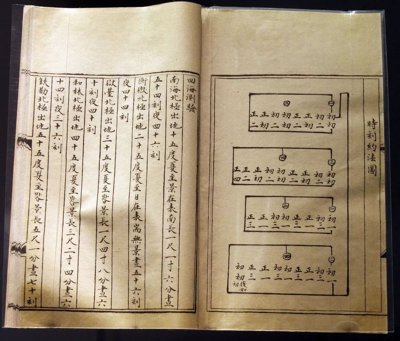
Guo Shoujing (1231–1316), courtesy name Ruosi, was from Xingtai in Shunde (present-day Xingtai, Hebei), an outstanding Yuan astronomer, mathematician and hydraulic engineer. After the Yuan unified China, the calendar in use grew ever less accurate, and Kublai Khan ordered Wang Xun, Guo Shoujing and others to revise it. Guo held that "the basis of a calendar lies in observation, and for observation nothing comes before instruments", so he first improved or created nearly twenty astronomical instruments. Among them the simplified armillary sphere reduced the armillary sphere to two independent observing devices and was highly accurate, over three hundred years ahead of comparable European instruments; the tall gnomon raised the traditional eight-chi gnomon to forty chi, improving the accuracy of measuring the sun's shadow, and the observatory at Dengfeng, Henan, is the remains of that gnomon site. He also led large-scale astronomical observations, setting up twenty-seven observation points across the country, from the North Sea (the Siberian region of present-day Russia) to the South China Sea, known as the "Four Seas Survey". After several years of work, Guo Shoujing and others completed the new Shoushi Calendar in 1280, promulgated the next year. 2425 days, only 26 seconds off the actual time of the Earth's orbit and identical to the present Gregorian calendar, but about 300 years before the Gregorian calendar was established. The Shoushi Calendar was used in China for over 360 years, one of the longest-used and most accurate calendars of ancient China. Guo also contributed in water management, directing the digging of the Tonghui Canal from Dadu to Tongzhou so that grain barges on the Grand Canal could reach the Jishuitan lake inside Dadu.
References
Text and images from Wikipedia are used under CC BY-SA and their respective licenses