TangAD 618–907
Japan Sends Embassies to Tang
Tang dynasty
Japan sent a dozen or so embassies to Tang China to study its institutions and culture. Abe no Nakamaro, Kibi no Makibi and others contributed greatly to Sino-Japanese exchange.
View on the timeline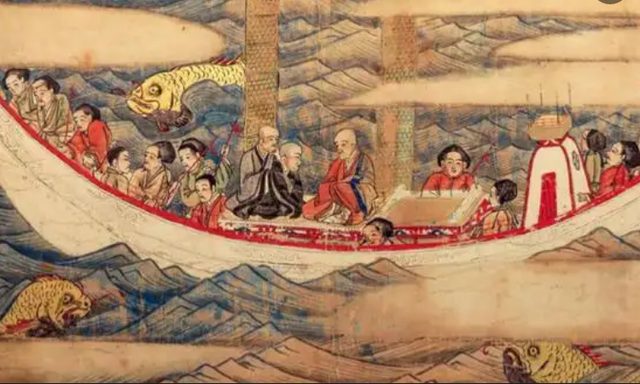
Tang China was powerful and culturally flourishing, and attracted neighboring countries. Japan had already sent “envoys to Sui” in the Sui dynasty. In 630 it sent its first embassy to Tang, and over the next two centuries sent a dozen or so more, the largest with over 500 people, accompanied by students, student monks and technicians. They studied Tang political institutions, law, writing, astronomy and calendrical science, books, calligraphy, architecture, music and Buddhism, and brought many books and objects back to Japan, with a profound effect on its development. In 645 Japan carried out the Taika Reform, applying a land allotment system modeled on Tang's equal-field and tax systems and building a centralized government on the Tang pattern; its capitals Heijo-kyo (present-day Nara) and Heian-kyo (present-day Kyoto) were also laid out after Chang'an. Tang clothing, the game of go and customs such as the Dragon Boat Festival also spread to Japan. Among the envoys, Abe no Nakamaro was outstanding. He came to Chang'an with an embassy in 717, took the Chinese name Chao Heng, passed the jinshi examination, and served in Tang office for more than fifty years, forming deep friendships with Li Bai and Wang Wei. In 753, on his voyage home, a storm struck and he was falsely reported dead; Li Bai wrote “Lament for Chao Qingheng” in mourning. He in fact made his way back to Chang'an and died in China. Memorials to him stand today in Xi'an and in Nara. The envoy exchanges are celebrated in the history of Sino-Japanese friendship; Japan stopped sending them in 894.
References
Text and images from Wikipedia are used under CC BY-SA and their respective licenses