Western Han202 BC–AD 8
Campaigns Against the Xiongnu (Battle of Mobei)
119 BC
Emperor Wu sent Wei Qing and Huo Qubing on repeated campaigns; the Battle of Mobei in 119 BC crushed the Xiongnu main force, leaving “no royal court south of the desert” and securing the frontier.
View on the timeline
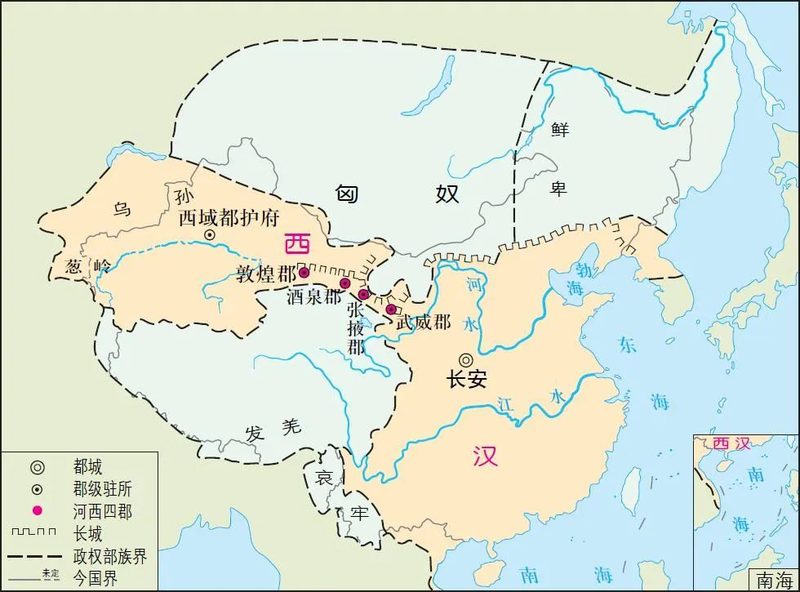
At the end of the Qin and start of the Han, the Xiongnu under Modu Chanyu united the Mongolian steppe and grew powerful, raiding southward constantly. After Emperor Gaozu was besieged at Baideng, the Han adopted “marriage alliances,” sending imperial women and gifts to the chanyu. After the prosperous reigns of Emperors Wen and Jing, the Western Han was strong, and Emperor Wu decided to end this passive stance, building a powerful cavalry to strike back. In 127 BC Wei Qing recovered the Henan region and set up Shuofang Commandery. In 121 BC the young general Huo Qubing twice attacked the Hexi region and defeated the Xiongnu; the Hunye king surrendered with his followers, and the Han set up Wuwei, Jiuquan and other commanderies (later adding Zhangye and Dunhuang), opening the Hexi Corridor to the Western Regions. In 119 BC Emperor Wu sent General-in-Chief Wei Qing and General Huo Qubing, each with 50,000 cavalry, in eastern and western columns deep into the north of the desert, in the largest campaign of the war, the Battle of Mobei. Wei Qing crossed the great desert and met the chanyu's main force; after a day of fierce fighting a gale rose at dusk, and Wei Qing sent troops to envelop both flanks, so that the chanyu was routed and fled. Huo Qubing advanced over 2,000 li north, defeated the Xiongnu Wise King of the Left, killed over 70,000, and pursued them to Mount Lang Juxu (in present-day Mongolia), where he held a sacrifice to Heaven, the “enfeoffment at Lang Juxu,” later the highest honor for a general. After Mobei the Xiongnu main force was crippled and forced to withdraw far away, and the threat to the northern frontier was largely lifted. Huo Qubing's saying, “While the Xiongnu are not destroyed, how can I think of a home?” has been remembered ever since.
References
Text and images from Wikipedia are used under CC BY-SA and their respective licenses