Qin221–207 BC
Burning of Books and Burying of Scholars
Reign of Qin Shi Huang
To control thought, Qin Shi Huang burned private copies of the Poems, Documents and philosophers on Li Si's advice, and the next year buried over 460 scholars alive.
View on the timeline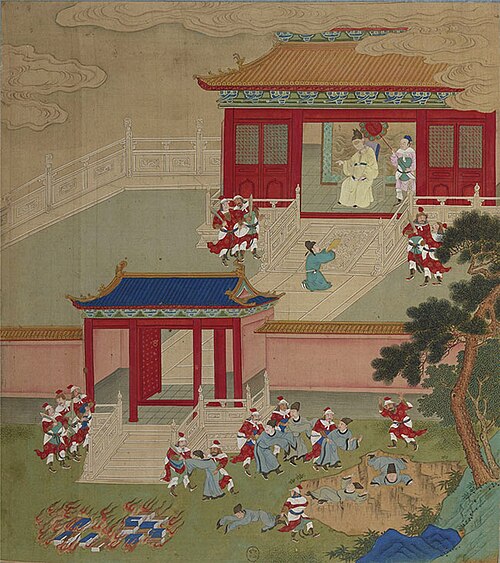
After Qin unified China, some Confucian scholars and men of letters still used the past to criticize the present, urged a return to enfeoffment and criticized Qin policy. In 213 BC Qin Shi Huang gave a banquet at the Xianyang palace, where the erudite Chunyu Yue proposed following the ancients in enfeoffing sons and meritorious officials. Chancellor Li Si firmly opposed this, arguing that scholars “using the past to criticize the present” would disturb people's minds and threaten unification, and proposed that, except for Qin's own histories and practical books on medicine, divination and tree planting, the Poems, Documents and works of the hundred schools held by private persons be delivered to officials and burned within a time limit; anyone daring to discuss the Poems and Documents would be executed, anyone using the past to criticize the present would have his clan wiped out, and those wishing to study the law should take officials as their teachers. Qin Shi Huang adopted the proposal, and many pre-Qin texts were lost as a result: this is the “burning of books.” The next year, 212 BC, the alchemists Hou Sheng and Lu Sheng, who had been seeking elixirs for Qin Shi Huang, slandered him and fled; the furious emperor ordered an investigation of the scholars in Xianyang, who informed against one another, and he buried alive more than 460 implicated people at Xianyang: this is the “burying of scholars.” Those buried included both alchemists and Confucians, so some scholars hold that the term “burying of Confucians” is not entirely accurate. His eldest son Fusu remonstrated and was sent north as army supervisor.
References
Text and images from Wikipedia are used under CC BY-SA and their respective licenses