Spring and Autumn770–476 BC
Classic of Poetry (Shijing)
Western Zhou to Spring and Autumn
The Classic of Poetry, China's first poetry anthology, collects 305 poems from the early Western Zhou to the mid-Spring and Autumn in three parts: Feng, Ya and Song.
View on the timeline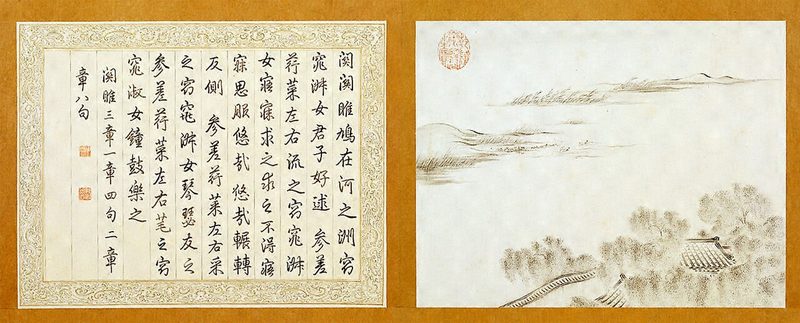
The Classic of Poetry (Shijing) is China's first anthology of poetry, collecting 305 poems from roughly 500 years, from the early Western Zhou to the middle Spring and Autumn period. In the pre-Qin period it was called the Poems or the “Three Hundred Poems,” and only when honored as a Confucian classic in the Western Han was it called the Shijing. By musical type it is divided into three parts, “Feng,” “Ya” and “Song.” “Feng,” the “Airs of the Fifteen States,” has 160 poems and consists of folk songs from different regions, the most realistic of all. “Ya,” divided into Greater and Lesser Ya, has 105 poems, mostly songs for banquets and court assemblies of the nobility. “Song,” including the Songs of Zhou, Lu and Shang, has 40 poems, songs for ancestral temple sacrifices. Its poems variously reflect working life and folk customs, celebrate love and noble sentiment, or expose the exploitation and oppression of rulers: “Big Rat” compares exploiters to a great rat, “Cutting Sandalwood” mocks nobles who gain without working, and “Guan Ju” and “Jian Jia” are beloved love poems. The Classic of Poetry is mainly in four-character lines, often uses repeated stanzas and the techniques of “fu, bi and xing” (narration, comparison and association), and its language is simple, beautiful and musical. Tradition says Confucius edited it and taught it to his disciples, saying, “If you do not study the Poems, you will have nothing to say.” It preserves rich materials on Shang and Zhou society, began the realist tradition of Chinese poetry and, with the romantic Chuci (Songs of Chu) represented by Qu Yuan, makes up “Feng and Sao,” and has deeply influenced poetry for over two thousand years.
References
Text and images from Wikipedia are used under CC BY-SA and their respective licenses