Neolithicc. 10,000 years ago–2070 BC
Abdication of Yao, Shun and Yu
Legendary era
Legend says Yao, Shun and Yu led the tribal alliance in turn, passing leadership to the worthy by abdication, which later Confucians saw as the ideal form of rule.
View on the timeline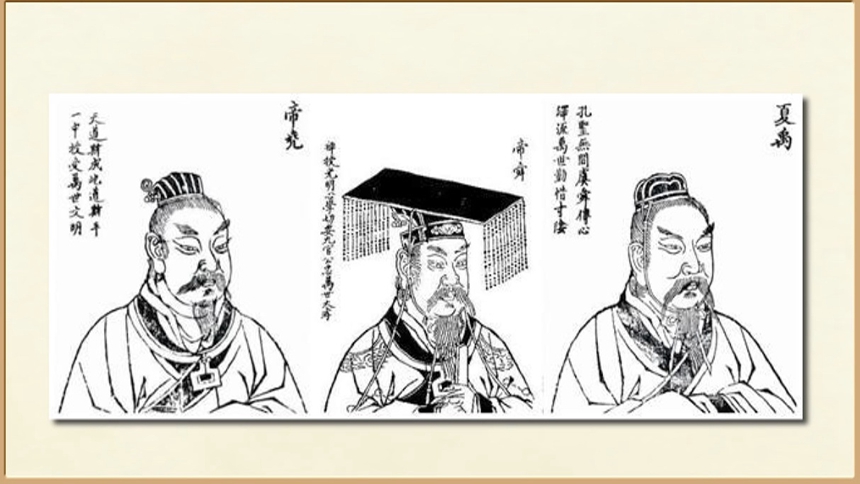
Tradition says that after the Yellow Emperor, many tribes lived in the Yellow River basin. To grow stronger, tribes such as the Taotang, Youyu and Xiahou formed an alliance, and Yao, Shun and Yu served in turn as its leader. A system of abdication was practiced: leadership was passed by selection to a capable and virtuous person rather than to one's own son. Yao is said to have encouraged people to clear farmland and ordered Xihe and others to observe the heavens and draw up a calendar, guiding people to farm on time. When Yao grew old, he consulted tribal leaders, who recommended Shun, known for his filial conduct. Yao tested Shun for years before yielding the leadership to him. Under Shun, penal laws were made, the worthy were chosen, institutions were improved and order kept; he also sent Yu to control the floods. When Shun grew old, he in turn yielded to Yu, who had succeeded in taming the floods. The abdication system reflects the democratic tradition of choosing leaders in tribal alliances at the end of primitive society. Later Confucians regarded it as the ideal of “the world as a shared possession,” and the Book of Rites (Liji), “Liyun,” sums up the age as one when “the Great Way prevailed and the world was shared by all; the worthy and able were chosen.” Some ancient texts, such as the Bamboo Annals, give different accounts of the abdications, showing how legendary this history is. After Yu died, his son Qi took the throne and the “world shared by all” became the “world owned by one family,” the abdication system being replaced by hereditary succession.
References
Text and images from Wikipedia are used under CC BY-SA and their respective licenses