People's Republic of China1949–present
Ping-Pong Diplomacy and Nixon's Visit to China
1971–1972
"Ping-pong diplomacy" in 1971 opened the door to contact between China and the United States, and Nixon's 1972 visit led to the Shanghai Communique and the start of normalization of relations.
View on the timeline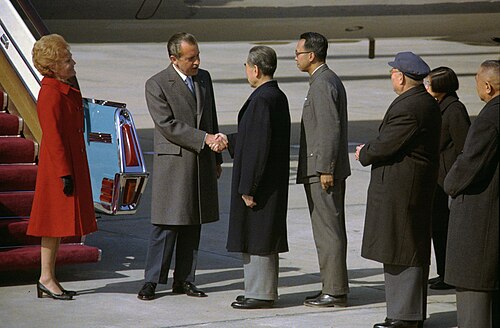
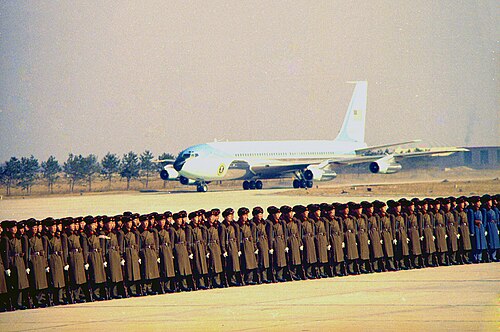
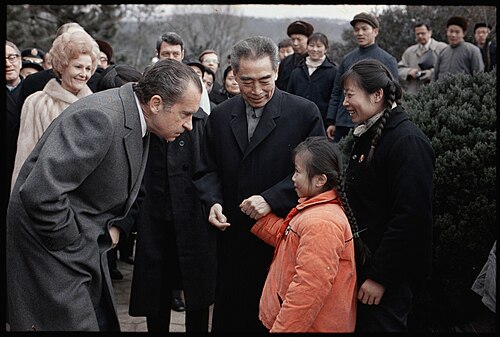
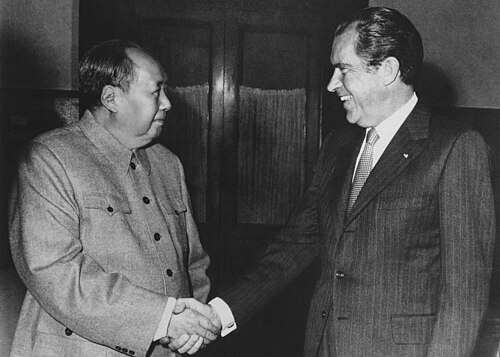
After New China's founding, the US government was hostile to it and followed a policy of blockade, embargo and encirclement, and relations between the two countries remained adversarial for a long time. In the late 1960s and early 1970s the international situation changed, and both countries needed better relations. In April 1971 the American table tennis team, in Nagoya, Japan, for the 31st World Table Tennis Championships, was invited to visit China, and Zhou Enlai received them, saying: "Your visit at our invitation has opened the door to friendly contacts between the peoples of our two countries." This was the famous "ping-pong diplomacy," described as "the small ball moving the big ball." In July the US national security adviser Henry Kissinger secretly visited China and held talks with Zhou Enlai to prepare for a presidential visit. In February 1972 President Richard Nixon visited China and was received by Mao Zedong. On 28 February the two sides signed the Joint Communique of the United States and China in Shanghai, known as the Shanghai Communique, in which the United States stated: "The United States acknowledges that all Chinese on either side of the Taiwan Strait maintain there is but one China and that Taiwan is a part of China. The United States Government does not challenge that position." The communique marked the start of normalization of relations and ended more than twenty years of confrontation. Nixon called the visit "the week that changed the world." The easing of Sino-US relations spurred China's relations with Western countries and set off another wave of diplomatic recognition after New China's founding. On 1 January 1979 China and the United States formally established diplomatic relations.
References
Text and images from Wikipedia are used under CC BY-SA and their respective licenses