QingAD 1644–1912
Wuchang Uprising and the Xinhai Revolution
10 October 1911
On 10 October 1911 revolutionaries in the Hubei New Army launched the Wuchang Uprising; provinces declared independence one after another and Qing rule swiftly collapsed.
View on the timeline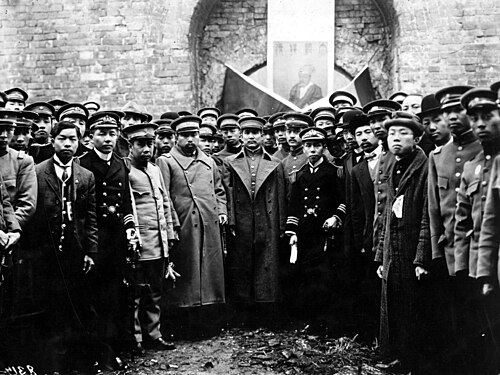
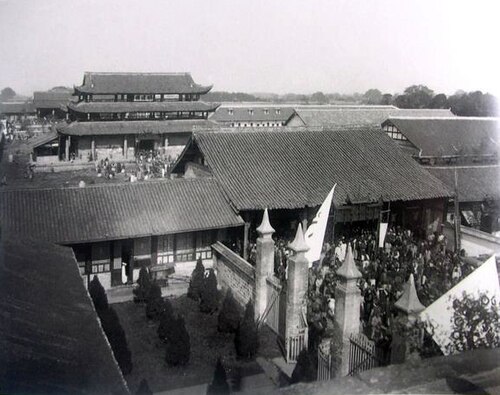
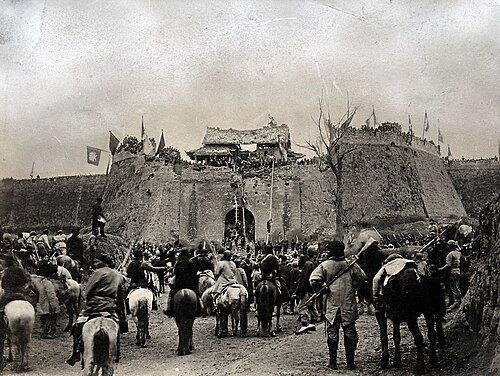
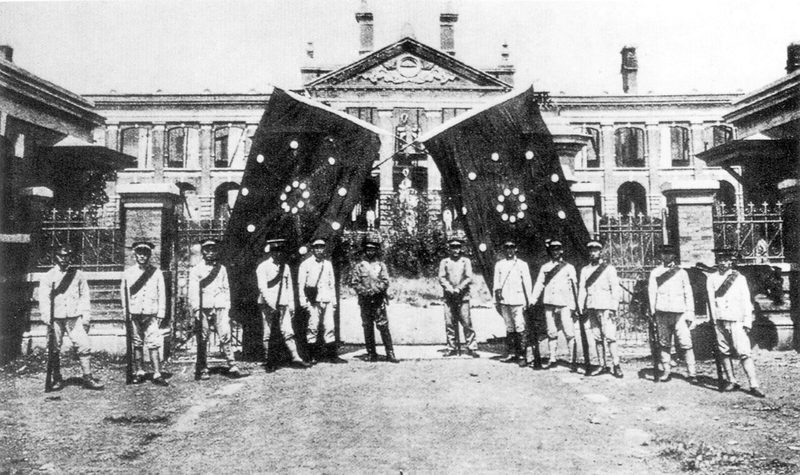
In May 1911 the Qing government formed a “Royal Cabinet” dominated by imperial clansmen and announced the “nationalization of railways”, taking over the Sichuan–Hankou and Guangzhou–Hankou lines that had been built with private funds. This provoked railway protection movements in Hunan, Hubei, Guangdong and Sichuan; in Sichuan the movement was fiercest and grew into an armed uprising. Meanwhile, the Hubei revolutionary groups Literary Society and Progressive Association, encouraged by the Tongmenghui, had recruited many members in the New Army and were planning an uprising. On 9 October, Sun Wu, a leader of the Progressive Association, accidentally set off a bomb while making explosives in the Russian concession at Hankou; the plan was exposed and the government made mass arrests from its lists of revolutionaries. In this desperate situation, on the night of 10 October, revolutionaries of the New Army's Eighth Engineer Battalion, led by Xiong Bingkun, were the first to act and fired the first shot of the Wuchang Uprising. After a night of fighting the rebels held Wuchang, and Hanyang and Hankou were soon recovered. They established the Hubei Military Government and chose Li Yuanhong, a New Army brigade commander, as military governor. Hunan, Shaanxi and other provinces followed, and within a little over a month more than ten provinces declared independence from the Qing, whose rule swiftly collapsed. Because 1911 was the xinhai year of the traditional calendar, the revolution is called the Xinhai Revolution. It overthrew the monarchy that had ruled China for over two thousand years, established the Republic of China and planted the idea of democratic republicanism in people's minds; it was a great bourgeois democratic revolution in modern Chinese history.
References
Text and images from Wikipedia are used under CC BY-SA and their respective licenses