Warring States475–221 BC
Partition of Jin and the Seven Warring States
Early Warring States · Spring and Autumn → Warring States
Jin was divided among Han, Zhao and Wei, and Qi passed to the Tian clan; in 403 BC the Zhou king recognized the three as lords, forming the Seven Warring States.
View on the timeline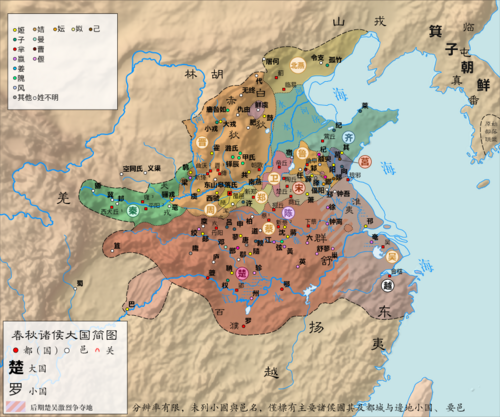
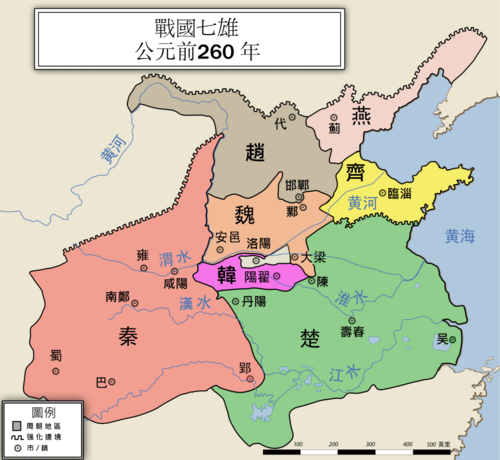
In the late Spring and Autumn period, powerful senior officials in some states grew stronger and gradually took over the government. In Jin, power long lay with six families of senior officials, Han, Zhao, Wei, Zhi, Fan and Zhonghang, who annexed one another until four were left: Han, Zhao, Wei and Zhi. In 453 BC Zhi Bo joined Han and Wei to besiege the Zhao at Jinyang; Zhao Xiangzi secretly persuaded Han and Wei to switch sides, and the three together destroyed the Zhi and divided most of Jin's land. In 403 BC King Weilie of Zhou formally recognized Han, Zhao and Wei as lords, known as the “Partition of Jin,” the three states together being called the “Three Jins.” Sima Guang's Zizhi Tongjian of the Northern Song begins its narrative with this year. In Qi, the Tian clan won the people's hearts by methods such as “lending with large measures and collecting with small ones” and gradually took power; in 386 BC Tian He was made Marquis of Qi by the Zhou king, known as “the Tian clan replacing Qi.” The stronger states of the Warring States period were thus Qi, Chu, Yan, Han, Zhao, Wei and Qin, the “Seven Warring States.” The Warring States period generally runs from 475 BC to 221 BC and takes its name from the Intrigues of the Warring States compiled by Liu Xiang of the Western Han. In this period the strong lords no longer used the slogan “revere the king, expel the barbarians”; the Zhou house survived in name only, and the states reformed to grow strong and expand their armies. Wars of annexation grew ever larger, with more troops, wider theaters and longer duration, and famous battles such as Guiling, Maling and Changping took place.

References
Text and images from Wikipedia are used under CC BY-SA and their respective licenses