People's Republic of China1949–present
The “1992 Consensus” and the Wang–Koo Talks
1990–1993
In 1992 the two cross-strait bodies each stated orally that “both sides of the Taiwan Strait adhere to the one-China principle,” the “1992 Consensus”; the Wang–Koo Talks were held in 1993.
View on the timeline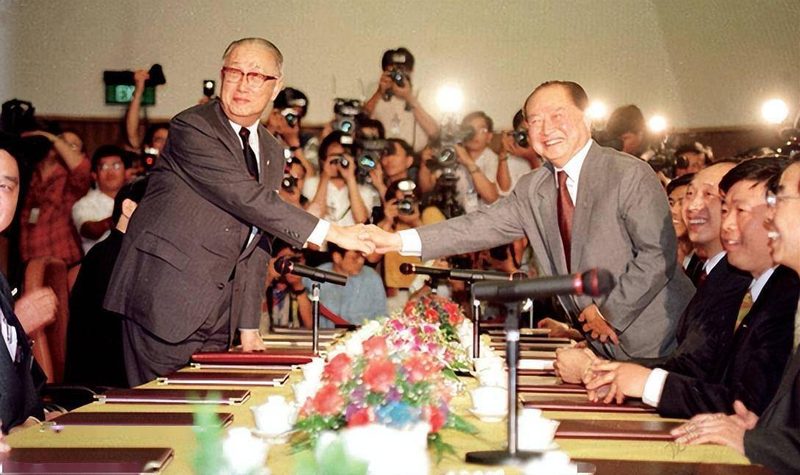
As cross-strait exchanges grew closer, Taiwan set up the Straits Exchange Foundation (SEF) in 1990 to handle practical issues arising from contacts, and the mainland set up the Association for Relations Across the Taiwan Straits (ARATS) the next year. In October 1992 ARATS and SEF met in Hong Kong to discuss how to state the one-China principle in their working-level talks. In November, after an exchange of letters and messages, the two bodies reached a consensus that each would state orally that “both sides of the Taiwan Strait adhere to the one-China principle,” known as the “1992 Consensus.” Its core is that the two sides belong to one China and work together toward national reunification. It is the political foundation of cross-strait relations and laid the basis for negotiations. In April 1993 ARATS president Wang Daohan and SEF chairman Koo Chen-fu met in Singapore, the first public talks between high-level cross-strait figures, in a non-governmental capacity, since 1949, known as the “Wang–Koo Talks.” They signed four agreements including the Wang–Koo Talks Joint Agreement. The talks marked an important historic step in cross-strait relations. Later, after Taiwan’s leader put forward separatist ideas such as the “two-state theory,” talks between the two bodies were for a time suspended. After 2008 the two bodies resumed talks on the basis of the 1992 Consensus and signed more than twenty agreements, including the Economic Cooperation Framework Agreement. In 2015 the leaders of the two sides met in Singapore. Upholding the 1992 Consensus and opposing “Taiwan independence” is the key to maintaining peace and stability across the Strait and promoting its peaceful development.
References
Text and images from Wikipedia are used under CC BY-SA and their respective licenses