People's Republic of China1949–present
The 863 Program and the 973 Program
1986 and 1997
In 1986 four scientists proposed tracking world high technology, leading to the “863 Program”; the “973 Program” followed in 1997, boosting scientific and technological development.
View on the timeline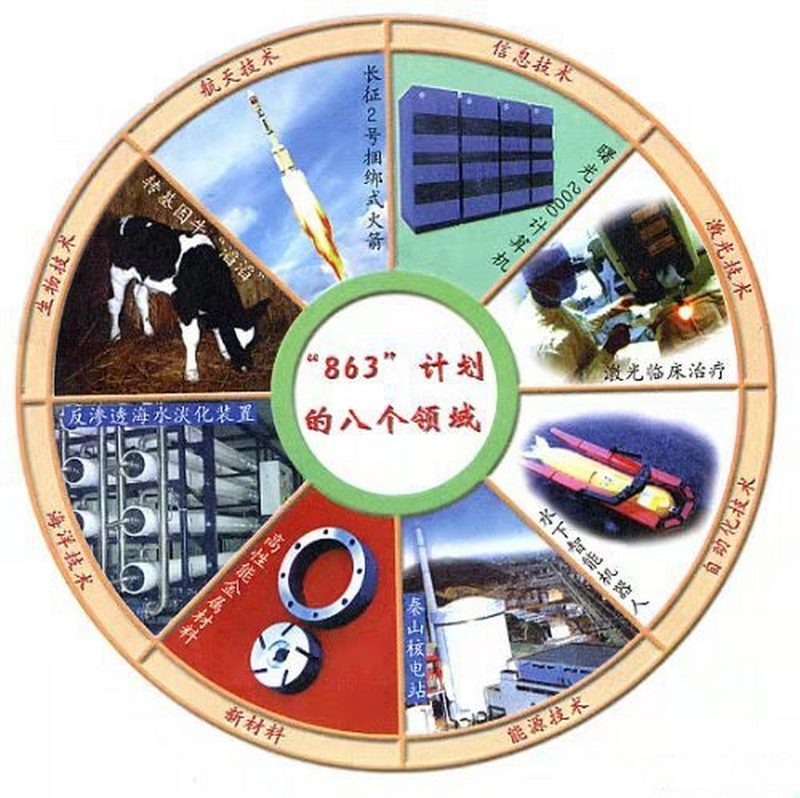
In the 1980s a new technological revolution was surging worldwide: the US announced its “Star Wars” program and Europe the “Eureka Project,” and competition in high technology grew fierce. In March 1986 four scientists, Wang Ganchang, Wang Daheng, Yang Jiaqi and Chen Fangyun, jointly submitted to the Party Central Committee their Proposal on Tracking the Development of Strategic High Technology in the World. After reading it Deng Xiaoping wrote: “This should be decided quickly, without delay.” That year the state drew up the Outline of the High-Tech Research and Development Program, known as the “863 Program” because the proposal and the instruction both date from March 1986. It singled out seven fields: biotechnology, space technology, information technology, laser technology, automation, energy technology and new materials, with marine technology added later, concentrating efforts to track world advanced levels. Driven by the program, China achieved a series of major results in high technology, such as the Dawning high-performance computers, some key technologies of the Shenzhou crewed spacecraft, super hybrid rice and human genome sequencing. In 1997 the state drew up the National Key Basic Research Development Plan, the “973 Program,” which mainly supported basic research in agriculture, energy, information, resources and environment, population and health, and materials. The two programs raised China’s capacity for scientific and technological innovation and narrowed the gap with developed countries. From 2016 they were merged into the National Key R&D Program.
References
Text and images from Wikipedia are used under CC BY-SA and their respective licenses