People's Republic of China1949–present
Message to Taiwan and One Country, Two Systems
From 1979
On New Year’s Day 1979 the NPC Standing Committee issued the Message to Compatriots in Taiwan proposing cross-strait “three links”; Deng Xiaoping later put forward “one country, two systems.”
View on the timeline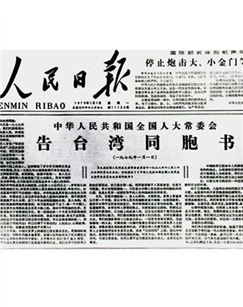
After the founding of the People’s Republic, the Party and government made reunifying Taiwan with the mainland a sacred mission. On 1 January 1979 the Standing Committee of the National People’s Congress issued the Message to Compatriots in Taiwan, announcing the major policy of peaceful reunification, proposing that the two sides quickly open postal, transport and trade links (the “three links”), and announcing a halt to shelling of Jinmen and other islands. In September 1981 Ye Jianying, chairman of the NPC Standing Committee, made a statement further setting out nine policies on Taiwan’s return and peaceful reunification (the “Ye Nine Points”), proposing that after reunification Taiwan could become a special administrative region with a high degree of autonomy and could keep its own armed forces. In 1982 Deng Xiaoping clearly put forward the concept of “one country, two systems” when meeting foreign guests. Its basic content is that, within the People’s Republic of China, the mainland upholds the socialist system while Taiwan, Hong Kong and Macao keep their existing capitalist systems and ways of life unchanged for a long time. The 1982 Constitution provides that the state may establish special administrative regions when necessary, giving “one country, two systems” a legal basis. “Peaceful reunification, one country, two systems” became China’s basic policy for resolving the Taiwan question. The concept was first applied successfully to Hong Kong and Macao. In 2005 the National People’s Congress passed the Anti-Secession Law, which states in legal form the Chinese people’s firm will to safeguard national sovereignty and territorial integrity. Achieving complete national reunification is the shared wish of all Chinese people.
References
Text and images from Wikipedia are used under CC BY-SA and their respective licenses