People's Republic of China1949–present
Xiaogang Village and Household Contracting
From 1978
In 1978 eighteen farming households in Xiaogang Village, Anhui, secretly signed a “contract everything to households” pact, opening rural reform that then spread nationwide.
View on the timeline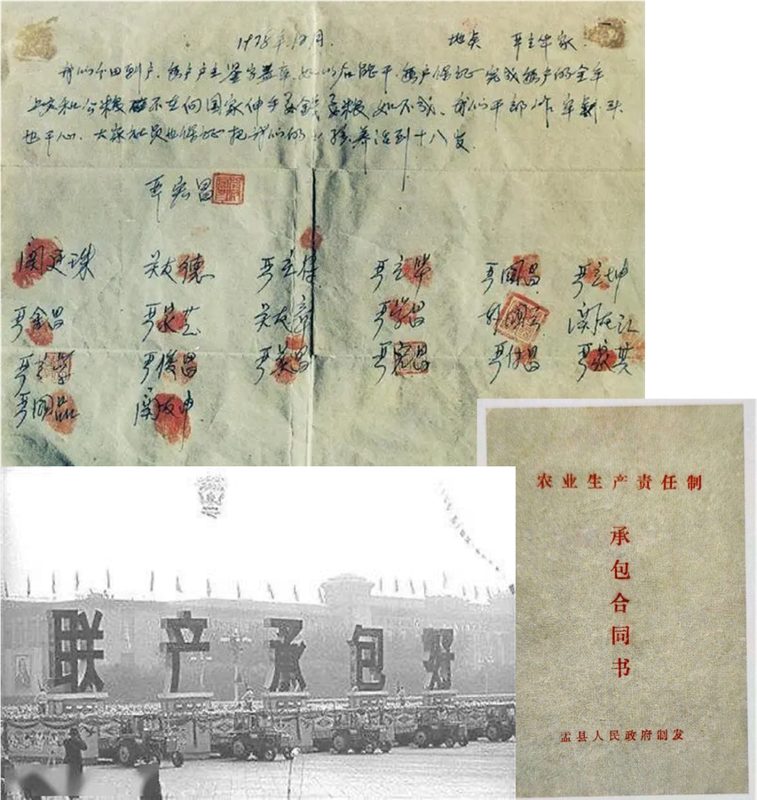
After the Third Plenary Session of the 11th Central Committee, reform began in the countryside. Under the people’s commune system, peasants had little incentive to produce and grain output stagnated for years. Xiaogang Village in Fengyang County, Anhui, was a well-known “three-reliances village”: it relied on resold grain for food, on relief for money and on loans for production. In the winter of 1978, eighteen households there secretly signed a contract in a thatched hut and pressed their red fingerprints on it, agreeing to divide the collective land among households to farm (“contracting everything to households,” dabaogan); they agreed that if cadres were jailed for it, the members would raise their children until the age of 18. The next year Xiaogang had a bumper harvest, with a total grain output equal to the sum of the five years from 1966 to 1970, ending more than twenty years of reliance on relief grain. The practice was at first controversial, but Deng Xiaoping clearly supported it and affirmed contracting output to households. From 1982 to 1986 the Central Committee issued “No. 1 Documents” on agriculture, rural areas and farmers for five consecutive years, endorsing the household responsibility system. Under it, land stays publicly owned but is contracted to farm households, who deliver their quota to the state, set aside what is due the collective, and keep the rest. It stimulated peasants’ enthusiasm, freed rural productive forces and raised grain output sharply; in 1984 national output exceeded 400 million tons, basically solving the problem of feeding the population. After 1983 the people’s communes were gradually replaced by township governments. Xiaogang is hailed as the “birthplace of China’s rural reform.”
References
Text and images from Wikipedia are used under CC BY-SA and their respective licenses