People's Republic of China1949–present
First Hydrogen Bomb Test
June 1967
China's first hydrogen bomb was successfully air-dropped and exploded on 17 June 1967, only two years and eight months after its first atomic bomb, among the fastest in the world.
View on the timeline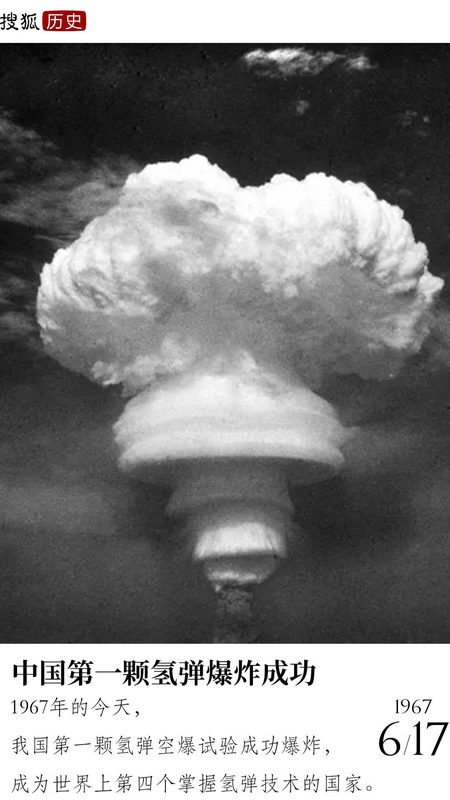
A hydrogen bomb is a nuclear weapon that releases enormous energy through the fusion of light nuclei such as the hydrogen isotopes deuterium and tritium. It is also called a thermonuclear weapon, and is far more powerful than an atomic bomb. After the first atomic bomb was exploded, the Party Central Committee and Mao Zedong asked for the hydrogen bomb to be developed faster. Scientists represented by Yu Min, Deng Jiaxian, Peng Huanwu, Huang Zuqia and Zhou Guangzhao explored hydrogen bomb principles on their own strength, with no foreign materials to consult. In 1965 Yu Min led a research group in Shanghai doing calculations and found the key to achieving self-sustaining thermonuclear burning, producing a largely complete theoretical design from principle to configuration, known as the "Yu Min configuration." In December 1966 China conducted a hydrogen bomb principle test, which succeeded. On 17 June 1967 China's first hydrogen bomb, dropped from a bomber, was successfully exploded over Lop Nur in Xinjiang, with a yield of 3.3 megatons of TNT. From first atomic bomb to first hydrogen bomb, the United States took over seven years, the Soviet Union about four, Britain over four, and France over eight, while China took only two years and eight months, among the fastest in the world. The success marked a new stage in the development of China's nuclear weapons and further broke the superpowers' nuclear monopoly. The scientists involved long worked anonymously and in silence; Yu Min was unknown to the public for decades, received the State Preeminent Science and Technology Award in 2014 and the Medal of the Republic in 2019, and Deng Jiaxian is honored as a "founding father of the Two Bombs."
References
Text and images from Wikipedia are used under CC BY-SA and their respective licenses