People's Republic of China1949–present
Synthesis of Crystalline Bovine Insulin
1965
In 1965 Chinese scientists achieved the world's first synthesis of crystalline bovine insulin, the first biologically active protein made artificially, a world-leading result.
View on the timeline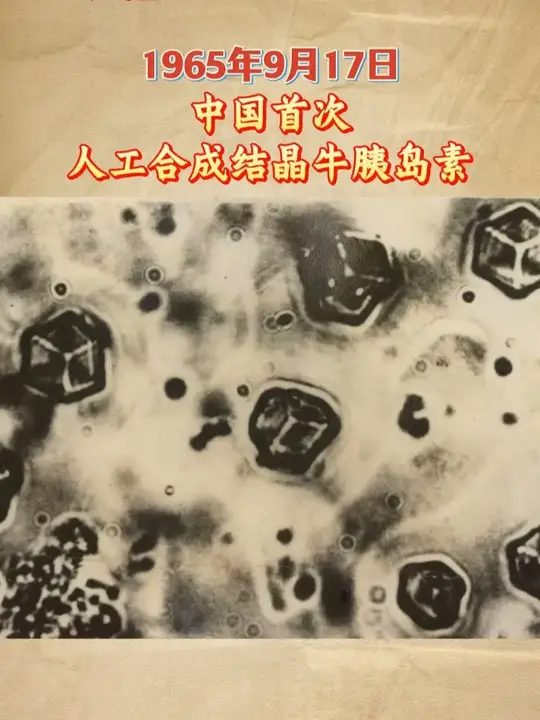
Insulin is a protein hormone secreted by the islet cells of the pancreas that regulates blood sugar and can be used to treat diabetes. In 1955 the British scientist Frederick Sanger determined the full amino acid sequence of bovine insulin, which consists of two peptide chains, A and B, with 51 amino acids in all, and won the 1958 Nobel Prize in Chemistry for it. Because proteins carry out the main functions of life, synthesizing a protein was seen as a key step toward unlocking the secrets of life. In 1958 the Shanghai Institute of Biochemistry of the Chinese Academy of Sciences proposed the project of synthesizing insulin, and a joint team was formed with the Shanghai Institute of Organic Chemistry and the Department of Chemistry at Peking University. Despite inexperience, simple equipment and shortages of materials, the researchers first synthesized the A and B chains separately and then joined them. After over six years of hard work, on 17 September 1965 Chinese scientists were the first in the world to synthesize crystalline bovine insulin with the same biological activity as the natural hormone. It was the first biologically active protein synthesized artificially and marked a crucial step in understanding life and probing its secrets, leading the world at the time. The result was published in Kexue Tongbao in 1966. In 1981 Chinese scientists went on to achieve the first synthesis of yeast alanine transfer RNA. In this period Yuan Longping also began his research on hybrid rice in 1964.
References
Text and images from Wikipedia are used under CC BY-SA and their respective licenses