People's Republic of China1949–present
Democratic Reform in Tibet
1959
In 1959 a reactionary clique in the Tibetan upper class launched an armed rebellion; after the central government put it down, democratic reform abolished feudal serfdom and freed a million serfs.
View on the timeline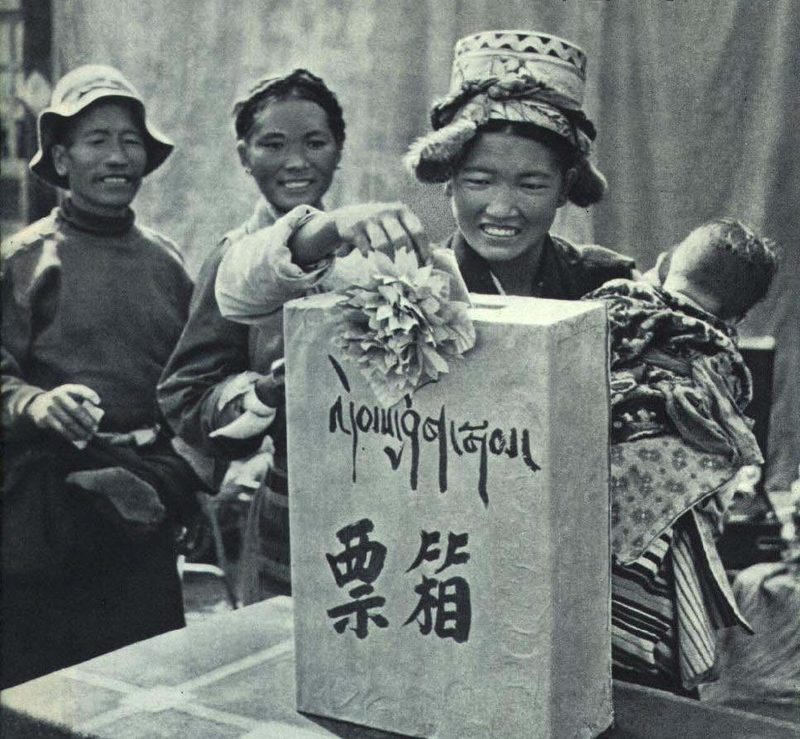
After the peaceful liberation of Tibet, the feudal serfdom that united religion and government remained in place. Three major lords, government officials, nobles and upper-ranking monks of the monasteries, under 5 percent of the population, held most of Tibet's farmland, pastures and livestock, while serfs and slaves, over 90 percent of the population, had neither means of production nor personal freedom. Under the Seventeen Point Agreement, the Central People's Government took a very cautious attitude toward reforming Tibet's social system, deciding that reform would be carried out by the Tibetan local government itself, and in 1957 announced "no reform for six years." But the reactionary clique of the Tibetan upper class, to preserve feudal serfdom forever and with the backing of foreign anti-China forces, openly tore up the Seventeen Point Agreement in March 1959 and launched a full-scale armed rebellion in Lhasa, and the 14th Dalai Lama fled to India. The People's Liberation Army units stationed in Tibet were ordered to put down the rebellion swiftly. On 28 March 1959 the State Council ordered the dissolution of the Tibetan local government. The Party Central Committee then decided to carry out democratic reform in Tibet while suppressing the rebellion. The reform abolished the feudal serf-owners' land ownership and the feudal serfdom that united religion and government. By 1961 democratic reform in Tibet was largely complete: a million serfs gained personal freedom, received land and means of production, and became masters of the country and society. In September 1965 the Tibet Autonomous Region was formally established and regional ethnic autonomy began. Democratic reform was the most extensive and profound social change in Tibetan history. In 2009 the Tibet Autonomous Region's People's Congress designated 28 March as "Serfs Emancipation Day."
References
Text and images from Wikipedia are used under CC BY-SA and their respective licenses