People's Republic of China1949–present
Wuhan Yangtze River Bridge Completed
1955–1957
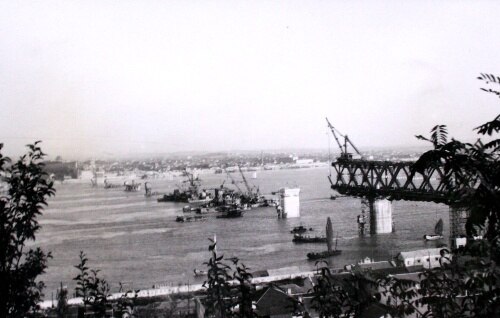
Construction of the Wuhan Yangtze River Bridge began in 1955 and it opened in October 1957, the first bridge across the Yangtze, turning a natural barrier into a thoroughfare.
View on the timeline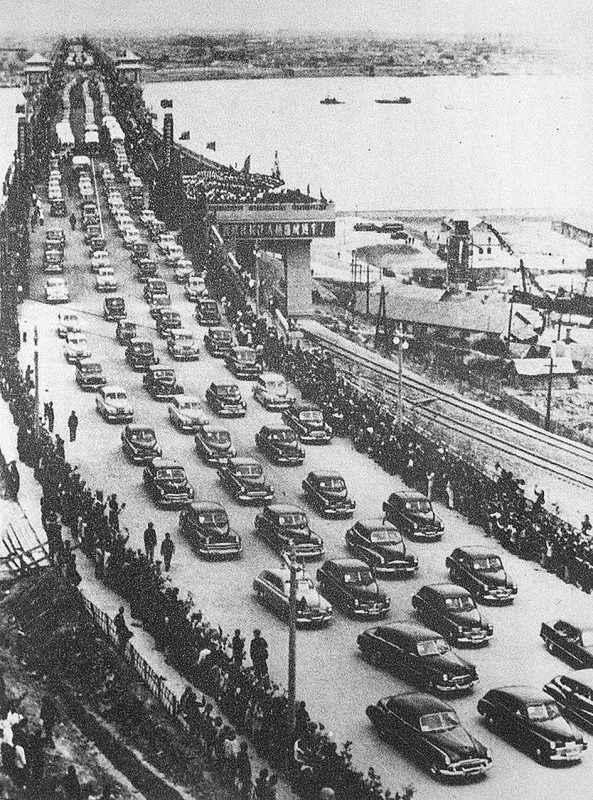
The Yangtze is China's longest river and historically a "natural moat" that cut off north-south travel. With no bridge, the Beijing-Hankou and Guangzhou-Hankou railways were severed by the river, and all goods and passengers going north or south had to cross by ferry. After New China's founding the Party and government decided to build the Wuhan Yangtze River Bridge. Work began in September 1955, with technical aid from Soviet experts such as Sylin; the Chinese bridge expert Mao Yisheng chaired the technical advisory committee, and Peng Min, head of the Railway Ministry's Bridge Engineering Bureau, directed construction. The builders used the "caisson-pile drilling method," then the most advanced in the world, to overcome the deep, fast water and complex geology. After over two years of intense work the Wuhan Yangtze River Bridge opened on 15 October 1957. It is 1,670 meters long, with a main bridge of 1,156 meters, and is a double-deck road and rail bridge, with a highway on top and a double-track railway below; the main bridge has eight piers and nine spans. It was the first bridge across the Yangtze, and its completion linked the Beijing-Hankou and Guangzhou-Hankou railways into the north-south Beijing-Guangzhou Railway and joined the three towns of Wuhan into one. In 1956, while the bridge was under construction, Mao Zedong swam the Yangtze and wrote the lines "A single bridge flies from north to south, turning a natural barrier into a thoroughfare." The bridge was one of the key projects of the First Five-Year Plan and marked a new level in China's bridge-building technology. In 1968 the Nanjing Yangtze River Bridge, designed and built by China itself, opened to traffic.
References
Text and images from Wikipedia are used under CC BY-SA and their respective licenses