Republic of ChinaAD 1912–1949
Jinggangshan Meeting and Armed Separatist Regime
April 1928
In April 1928 Zhu De and Chen Yi's troops joined Mao Zedong's at Jinggangshan to form the Fourth Red Army, and Mao summed up the idea of an “armed separatist regime of workers and peasants”.
View on the timeline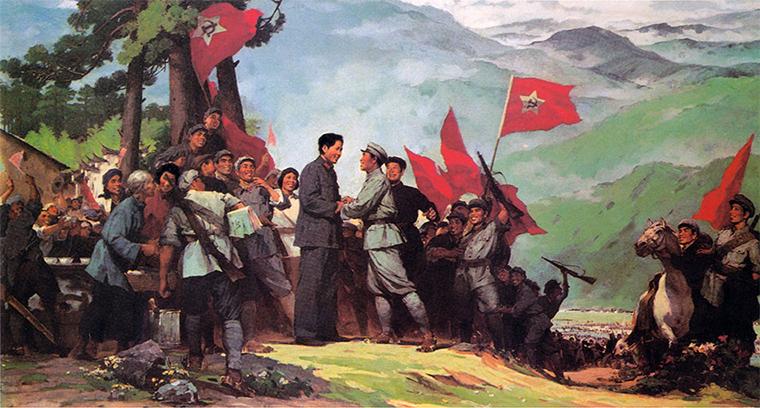
After the Nanchang Uprising failed, Zhu De and Chen Yi led the remnants through the border areas of Fujian, Guangdong, Jiangxi and Hunan, and in January 1928 launched the Southern Hunan Uprising, setting up soviet governments in several counties. In April 1928 their forces joined Mao Zedong's Workers' and Peasants' Revolutionary Army at Longshi in Ninggang on Jinggangshan, the “Meeting at Jinggangshan”. The two forces merged into the Fourth Army of the Chinese Workers' and Peasants' Revolutionary Army, soon renamed the Fourth Army of the Chinese Workers' and Peasants' Red Army, with Zhu De as commander and Mao Zedong as Party representative, over 10,000 men in all. The Fourth Red Army repeatedly broke Kuomintang “suppression” and “joint suppression” campaigns, and the base kept growing. In the struggle the Red Army summed up the sixteen-character guerrilla formula: “When the enemy advances, we retreat; when the enemy halts, we harass; when the enemy tires, we attack; when the enemy retreats, we pursue”, and drew up the “Three Main Rules of Discipline and Six Points for Attention” (later developed into the “Three Main Rules of Discipline and Eight Points for Attention”). Mao summed up the base's experience in “Why Is It That Red Political Power Can Exist in China?” and “The Struggle in the Jinggang Mountains”, advancing the idea of an “armed separatist regime of workers and peasants”. In January 1929 Mao and Zhu led the main force of the Fourth Red Army into southern Jiangxi and western Fujian, opening up the Central Revolutionary Base. The Jinggangshan struggle gave rise to the Jinggangshan spirit: “firm conviction and arduous struggle, seeking truth from facts and blazing new paths, relying on the masses and daring to win”.
References
Text and images from Wikipedia are used under CC BY-SA and their respective licenses