YuanAD 1271–1368
Yuan Post Stations and the Maritime Silk Road at Its Height
Yuan Dynasty
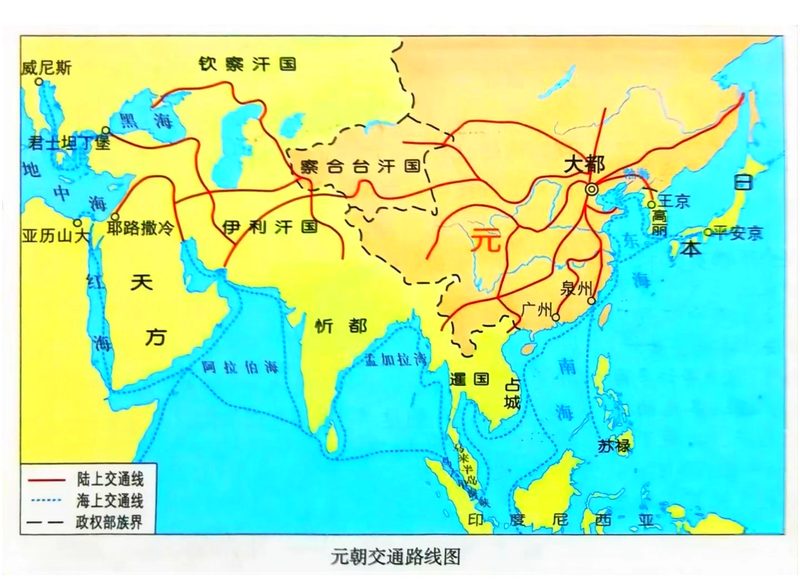
The Yuan built a far-reaching post-station network, with land routes to Europe and sea routes to East Africa; Quanzhou was hailed as the "greatest port of the East".
View on the timeline
In the Song and Yuan periods, communication with other countries grew greatly. The Yuan's territory was vast, and to strengthen rule and links it built a national road network centered on Dadu and a far-reaching system of post stations. The Yuan post stations were called "zhanchi"; over 1,500 were set up nationwide, each equipped with horses, oxen, donkeys, carts and boats for officials, envoys and the relay of official documents, and the government-issued travel credentials were called "paizi". The Yuan's land routes ran west to Central Asia, West Asia and Europe, and the ancient overland Silk Road was more open than ever; European merchants, missionaries and envoys came to China in an endless stream, and Marco Polo reached the Yuan along this route. By sea, the Yuan inherited and developed the Song's overseas trade, setting up maritime trade offices at ports such as Quanzhou, Guangzhou, Qingyuan (present-day Ningbo), Shanghai and Hangzhou. Quanzhou was one of the world's largest ports, hailed as the "greatest port of the East", with merchant ships from around the world in its harbor and many foreign merchants living in the city. Yuan ships sailed to Southeast Asia, South Asia, the Arabian Peninsula and the east coast of Africa, trading with over a hundred countries and regions. The Yuan navigator Wang Dayuan twice went to sea on merchant ships, visiting many places in Southeast Asia and along the Indian Ocean, and wrote Daoyi Zhilue (A Brief Account of the Island Barbarians), recording the customs and products of over two hundred countries and regions. In 2021 "Quanzhou: Emporium of the World in Song-Yuan China" was inscribed on the World Heritage List.

References
Text and images from Wikipedia are used under CC BY-SA and their respective licenses