Northern SongAD 960–1127
Champa Rice and the Growth of Song Agriculture
Northern Song
Early-ripening, drought-tolerant Champa rice, introduced from Vietnam, spread across the Yangtze–Huai region. Southern farming grew fast: “When Suzhou and Huzhou have a harvest, the world has enough”.
View on the timeline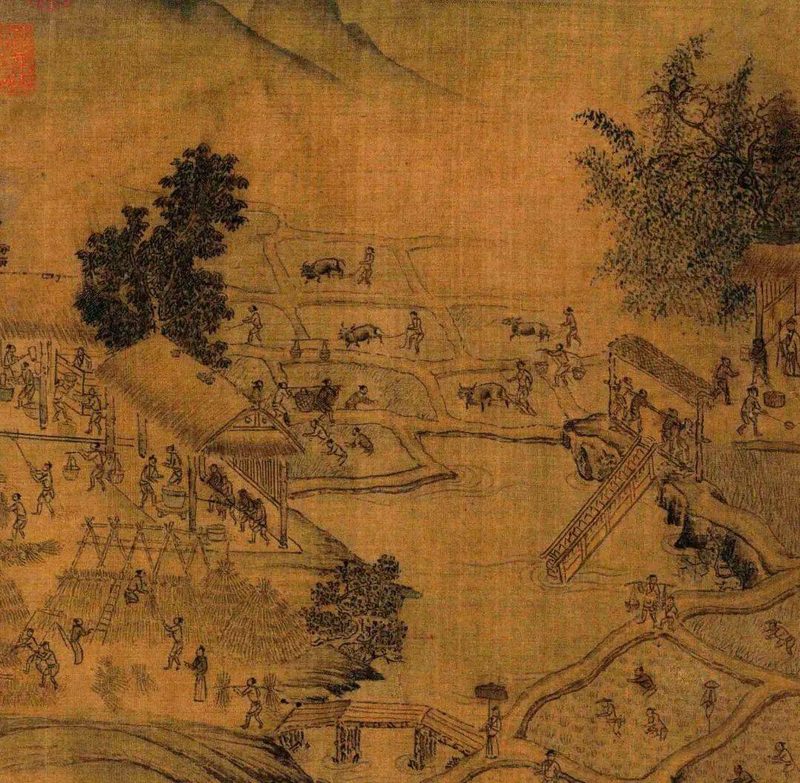
From the late Eastern Han, Jiangnan's society and economy had been developing. From mid-to-late Tang through the Song, large numbers of northerners moved south bringing advanced production techniques, and southern agriculture accelerated and gradually overtook the north. In the Song, population grew, cultivated land expanded and farming methods improved, bringing unprecedented agricultural growth. The area under southern rice grew quickly. Champa rice, originally from Champa (central and southern Vietnam today), ripens early, tolerates drought and adapts well. In 1012 (the fifth year of Dazhong Xiangfu under Emperor Zhenzong), drought struck the Yangtze–Huai and Liangzhe regions; Zhenzong had 30,000 hu of Champa seed fetched from Fujian, distributed it for planting there, and had farmers taught how to grow it. Champa rice then spread across the south and, bred with existing varieties, produced many early-ripening strains, raising yields greatly and allowing two crops a year in some places. Southern farmers also built polder fields in the Lake Tai region, terraced hills and mountains, and reclaimed fields along lakeshores. Northern wheat was also adopted in the south, and a rice–wheat rotation appeared in Jiangnan. The Lake Tai basin became the country's most important granary, giving rise to the saying “When Suzhou and Huzhou have a harvest, the world has enough”. Cotton spread from Guangdong, Guangxi and Fujian to the Yangtze valley, and tea cultivation expanded. Agricultural growth promoted crafts and commerce and laid a firm foundation for the shift of the economic center southward. In the Southern Song, Lou Shou's Pictures of Tilling and Weaving vividly depicts Jiangnan farmers plowing and weaving.

References
Text and images from Wikipedia are used under CC BY-SA and their respective licenses