Eastern HanAD 25–220
Zhang Zhongjing and the Treatise on Cold Damage
Late Eastern Han
The physician Zhang Zhongjing wrote the Treatise on Cold Damage and Miscellaneous Diseases, establishing pattern-based treatment; he is honored as the “Sage of Medicine.”
View on the timeline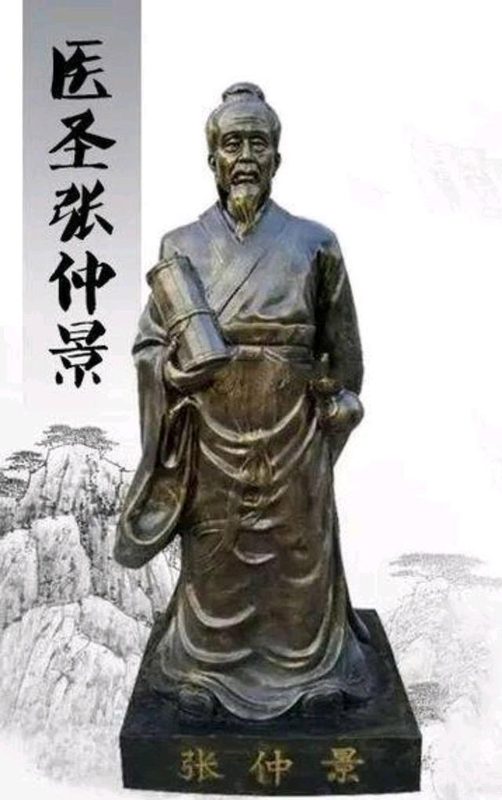
Traditional Chinese medicine has a long history and by the Han had reached a high level. Bian Que of the Warring States summed up the four diagnostic methods still used today; the Yellow Emperor's Inner Canon laid the theoretical foundation of Chinese medicine; and the Divine Husbandman's Classic of Materia Medica is China's earliest surviving pharmacological work. Zhang Zhongjing, personal name Ji, from Nieyang in Nanyang Commandery (around present-day Dengzhou, Henan), was a famous physician of the late Eastern Han. Tradition says that as governor of Changsha he treated patients in his official hall, the origin of the term “sitting in the hall” (zuotang) for a doctor seeing patients. In the late Eastern Han, with frequent wars and epidemics, his clan of over two hundred lost two-thirds in under ten years, seven-tenths of them to cold damage (typhoid-type illness). Grieved, he resolved to study medicine, sought out famous doctors, collected folk prescriptions, and, drawing on earlier work and his own practice, wrote the Treatise on Cold Damage and Miscellaneous Diseases in sixteen volumes. It systematically describes the causes, symptoms, diagnosis and treatment of many externally contracted and internal diseases, proposes the principle of “treatment by pattern differentiation,” matching drugs to a patient's symptoms and constitution, and records many effective formulas, earning it the name “ancestor of formula books.” The original was lost in wartime; edited by Wang Shuhe of the Jin and others, it survives as two classics, the Treatise on Cold Damage and the Essential Prescriptions of the Golden Cabinet. Zhang Zhongjing is honored as the “Sage of Medicine,” also influential in Japan and Korea.
References
Text and images from Wikipedia are used under CC BY-SA and their respective licenses